

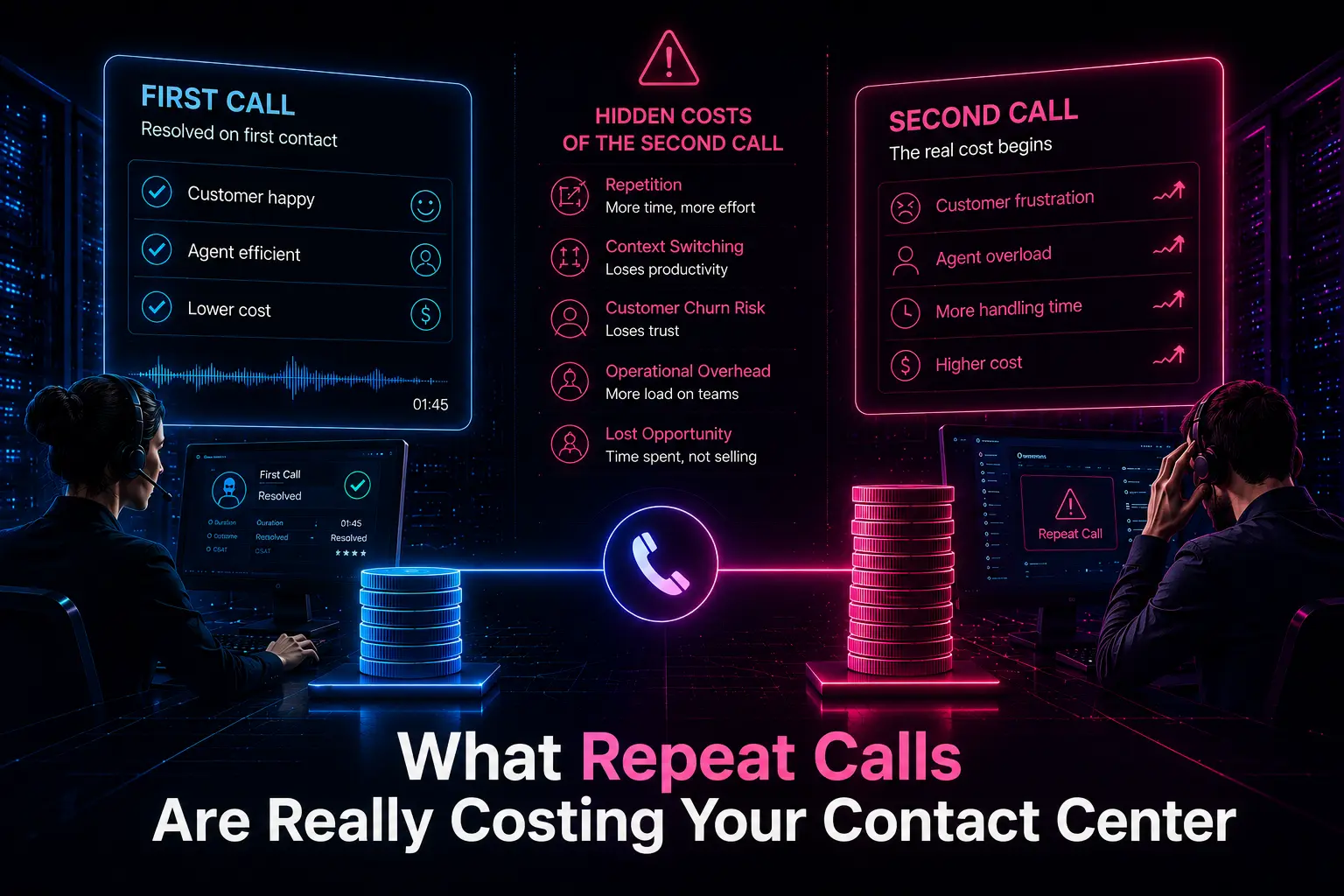
The repeat call is one of the most expensive events in customer service – and one of the least measured. A customer who calls twice about the same issue costs your operation more than double. They cost you the original handling time, the repeat handling time, the damage to the relationship, and in many cases, their future business.
The good news: repeat calls are almost entirely preventable. Here's what's driving them, how to calculate what they're costing you, and what modern contact center automation does to stop them.
The repeat call problem no one is measuring
Ask a contact center manager their average handle time. They'll tell you instantly.
Ask them what percentage of today's calls are from customers who already called this week. Most will have no idea.
That gap is the problem.
Industry benchmarks suggest that 25 to 30% of inbound call volume at a typical contact center is repeat contact – customers calling back about the same issue that wasn't fully resolved the first time. In some sectors, particularly finance and telecoms, that number exceeds 40%.
Each of those repeat calls represents a failure at the first interaction. And unlike a new call, a repeat call arrives with a customer who is already frustrated, already skeptical, and already forming a view about whether this company is worth staying with.
What a repeat call actually costs
The full cost of a repeat call has three layers that rarely appear in the same report.
1. Double the operational cost. Every repeat call is a call that didn't need to happen. You pay the handle time once for the original interaction and again for the follow-up. For a contact center operations team averaging five-minute calls at a loaded agent cost of $0.45 per minute, that's $4.50 per repeat call before you account for anything else. At 300 repeat calls per day, that's $1,350 in avoidable daily cost – or roughly $400,000 a year.
2. Elevated churn risk. Customers who have to call twice about the same issue churn at significantly higher rates than those whose issues are resolved on the first call. Research from the Customer Contact Council found that customers who experience high-effort interactions – which repeat calls almost always are – are four times more likely to be disloyal than those who receive low-effort service. In MENA markets, where alternatives are increasingly available and word of mouth travels fast, that churn risk is not theoretical.
3. Agent performance drag. Repeat callers tend to be harder to handle. They're impatient. They've already explained the issue once and they don't want to do it again. That emotional load sits with the agent, increases average handle time, and, over time, contributes to the burnout that drives turnover. The best agents on your customer service teams end up spending a disproportionate share of their time managing the fallout from problems that earlier interactions should have resolved.
A simple formula to run on your own data
Here's a repeat-call cost model you can run in any spreadsheet:
Monthly repeat call cost = (Total calls × Repeat rate × Average handle time × Loaded agent cost per minute) + (Repeat calls × Estimated monthly churn rate × Customer lifetime value)
Let's run it for a mid-sized regional contact center:
- Monthly call volume: 20,000 calls
- Repeat rate: 28%
- Average handle time: 5 minutes
- Loaded agent cost: $0.45 per minute
- Monthly churn rate from repeat callers: 2%
- Average customer lifetime value: $900
Operational cost: 5,600 repeat calls × 5 minutes × $0.45 = $12,600/month Churn cost: 5,600 × 2% × $900 = $100,800/month Total: $113,400/month – or $1.36 million per year.
The churn number is always the bigger number. Operational savings from reducing repeat calls are real, but the customer retention impact is where the commercial case is made.
Why repeat calls happen
Repeat calls are not a staffing problem. They're a resolution problem. The KPI that sits at the center of this problem is First Contact Resolution (FCR) — whether the customer's issue was fully resolved on the first call, without needing to call back.
Four root causes appear consistently across contact center operations:
Incomplete resolution. The most common cause. The agent addressed the symptom, not the underlying issue. The customer called about a billing discrepancy; the agent adjusted the bill but didn't investigate why it happened. Two weeks later, the same discrepancy appears and the same customer calls again.
Partial information. The agent gave an answer that was accurate at the time but didn't account for what the customer actually needed to know. A promised callback didn't arrive. A case was "escalated" with no follow-up. The customer calls again because nothing has changed.
Wrong channel or wrong agent. The issue required specialist knowledge or access to a system the first agent couldn't reach. Rather than being transferred to the right person, the customer was given a partial answer and sent away. This is a routing failure, not an agent failure.
No post-call follow-through. Some issues require action after the call – a form to be submitted, an account to be updated, a confirmation to be sent. When post-call steps are manual and unmeasured, they get missed. The customer calls back to check. The agent has no record of the previous interaction. The cycle continues.
In most contact center operations, all four causes are present simultaneously.
The industries where repeat calls hit hardest
Repeat calls are costly in every sector. In some, they're catastrophic.
Telecoms. Billing disputes, plan changes, and technical faults are structurally prone to repeat contact. A fault that isn't fully diagnosed on the first call will generate three to five follow-up calls. Providers that don't track repeat contact at the account level rarely realize how much of their volume is the same customers, over and over.
Banking and finance. Loan applications, account restrictions, and fraud alerts require multiple systems and approvals. Agents who can't complete the full resolution in one call create a follow-up queue that compounds quickly. High-value customers are especially likely to churn when the process requires repeated effort on their part.
Real estate. Property transactions are high-stakes and time-sensitive. A buyer or tenant who has to call twice to get the same information updated, or who receives conflicting answers from different agents, doesn't just lose trust in the agent – they lose trust in the brand.
Government and utilities. Customers have no alternative, which means repeat calls accumulate without triggering visible churn. But the volume cost is severe, and customer frustration builds into a pattern of distrust that takes years to reverse.
What AI does that changes the repeat call rate
There are two distinct places where AI changes the math on repeat calls: during the call, and after it.
During the call: AI voice agent and virtual agent handling. For high-volume, low-complexity queries – balance checks, appointment confirmations, status updates – an AI voice agent (sometimes called a virtual agent) handles the full interaction end to end using natural language processing (NLP). NLP customer service means callers can describe their issue the way they would to a human, and the system understands and acts on it. Unlike a menu-based IVR, a conversational AI platform doesn't force customers to map their question onto someone else's menu structure. It never gives a partial answer because it has access to live data and knowledge bases in real time. It never misses a follow-up because there is no follow-up to miss. Removing these interactions from the human queue also means your customer service teams can give their full attention to the complex cases where incomplete resolution is most costly – and customers get reduced wait times across the board.
During the call: real-time agent assistance. Real-time agent assistance tools surface relevant information automatically as a call progresses. When an agent is speaking with a customer about a billing dispute, the AI contact center platform pulls the account history, flags previous interactions on the same topic, and suggests the resolution that worked in similar cases. The agent spends less time searching and more time resolving. Cases that would previously have required a callback or escalation get closed in the first interaction – and customers receive more customized experiences from agents who arrive fully prepared.
After the call: automated case completion and automation workflows. Post-call automation workflows can trigger follow-up actions automatically – sending a confirmation, updating the CRM, scheduling the callback, escalating the unresolved case to a specialist. The loop closes without relying on an agent to remember to do it. Repeat calls driven by missed follow-through drop significantly within the first month of deployment. This is what contact center automation looks like in practice: not just answering calls faster, but closing cases completely.
After the call: post-call analytics and automated quality assurance. Modern AI customer service platforms analyze every conversation automatically. An automated quality assurance contact center tool reviews 100% of calls, not the 2 to 5% a manual QA process can cover. Post-call analytics surface real time insights: which issue categories generate the most callbacks, which agents have above-average repeat rates, which resolution scripts are failing in practice, and where the customer journey breaks down. That intelligence turns a reactive problem into a proactive one. Supervisors get actionable insights every morning instead of waiting for a monthly report. The result is a continuously improving feedback loop – coaching becomes targeted, and the service operation gets smarter with every call.
Your AI customer service buyer's guide: key features to look for
Not every AI customer service platform delivers what it promises. If you're evaluating options, this short ai customer service buyer's guide covers the key features that matter specifically for reducing repeat contact.
Multilingual support. If you serve the MENA region, your platform needs to handle Khaleeji, Egyptian, and MSA dialects naturally – not just standard Arabic. Most global tools fail this test. Multilingual support isn't an add-on; it's a prerequisite.
True omnichannel coverage. An omnichannel ai platform routes voice, WhatsApp, chat, and email through the same customer journey, with the same context. Repeat calls often happen because customers switched channels and had to start from scratch. A unified omnichannel ai platform eliminates that.
Custom conversational flows. You should be able to build and edit your own custom conversational flows without writing code. A conversational ai platform with visual flow builders lets your team automate routine queries specific to your business – not just generic use cases.
Agentic AI capabilities. Newer AI voice agents go beyond conversation. Agentic AI takes action – booking the appointment, updating the CRM, sending the confirmation – without handing back to a human. Cases close in the first interaction because the system doesn't just talk, it does the work.
NLP customer service at scale. Natural language processing NLP is the engine that makes all of this work. Look for a platform where NLP customer service capabilities extend across channels – the same understanding that handles a voice call should power your chat, WhatsApp, and email interactions.
Post-call analytics and automated QA. Manual quality assurance reviews a fraction of calls. Automated quality assurance at the contact center level reviews all of them. Look for post-call analytics that surface real time insights – sentiment, intent, resolution status, agent performance – automatically, and feed directly into your coaching process.
CRM and knowledge bases integration. Your ai contact center platform should plug into your existing CRM and read from your knowledge bases so agents and AI alike give customers the same accurate answers every time.
Frequently asked questions
What's a healthy repeat contact rate? Under 15% is strong. 15 to 25% is average. Anything above 25% indicates a systemic resolution problem – usually in your scripts, your routing, or your post-call follow-through.
Does an AI voice agent really reduce repeat calls? Yes – for the right query types. Routine queries handled end-to-end by an AI voice agent have near-zero repeat rates because the system accesses live data, closes the case in full, and triggers any follow-up actions automatically.
How does automated QA help with repeat calls? By identifying the patterns behind them. An automated quality assurance contact center tool surfaces the calls where resolution was incomplete – by issue type, agent, and product – so you can fix the process rather than manage the symptom.
What's the fastest fix for repeat calls? Close the post-call loop. Most repeat calls are driven by missed follow-through, not bad conversations. Automation workflows that trigger confirmations, updates, and escalations automatically tend to cut repeat rates by 20 to 30% within the first few weeks.
First Contact Resolution (FCR): The Metric That Predicts Everything Else
First Contact Resolution (FCR) is not a new metric. Most contact center leaders know what it means. Fewer than half measure it correctly, and most of those treat it as a reporting number rather than a management tool.
FCR is the single metric that most directly predicts repeat contact rate, customer satisfaction, agent performance, and long-term churn. When it improves, everything else tends to improve with it. When it doesn't, no amount of staffing or optimization elsewhere will move the needle on repeat calls.
The question is not whether you're measuring FCR. It's whether you're measuring it on every call, with enough context to actually improve it.
Manual measurement – supervisors listening to samples, agents self-reporting – gives you a number. Automated measurement across 100% of your call volume gives you insight. The difference between the two is where most contact center improvement programs stall.
Run your own repeat call audit
Pull 30 days of inbound call data and look for customers who called more than once about the same issue category. Calculate what percentage of your volume that represents. Apply the formula above.
If your monthly repeat-call cost exceeds what a modern ai customer service platform costs to deploy, the decision has already made itself.
ZIWO's cloud contact center platform includes real-time agent assistance, an AI voice agent that handles routine interactions end-to-end, automated quality assurance, post-call analytics, and contact center automation built for the Arabic, English, and French-speaking markets of the MENA region – all in a single omnichannel ai platform.
Book a demo and we'll walk through your repeat-call numbers using your own data.


