

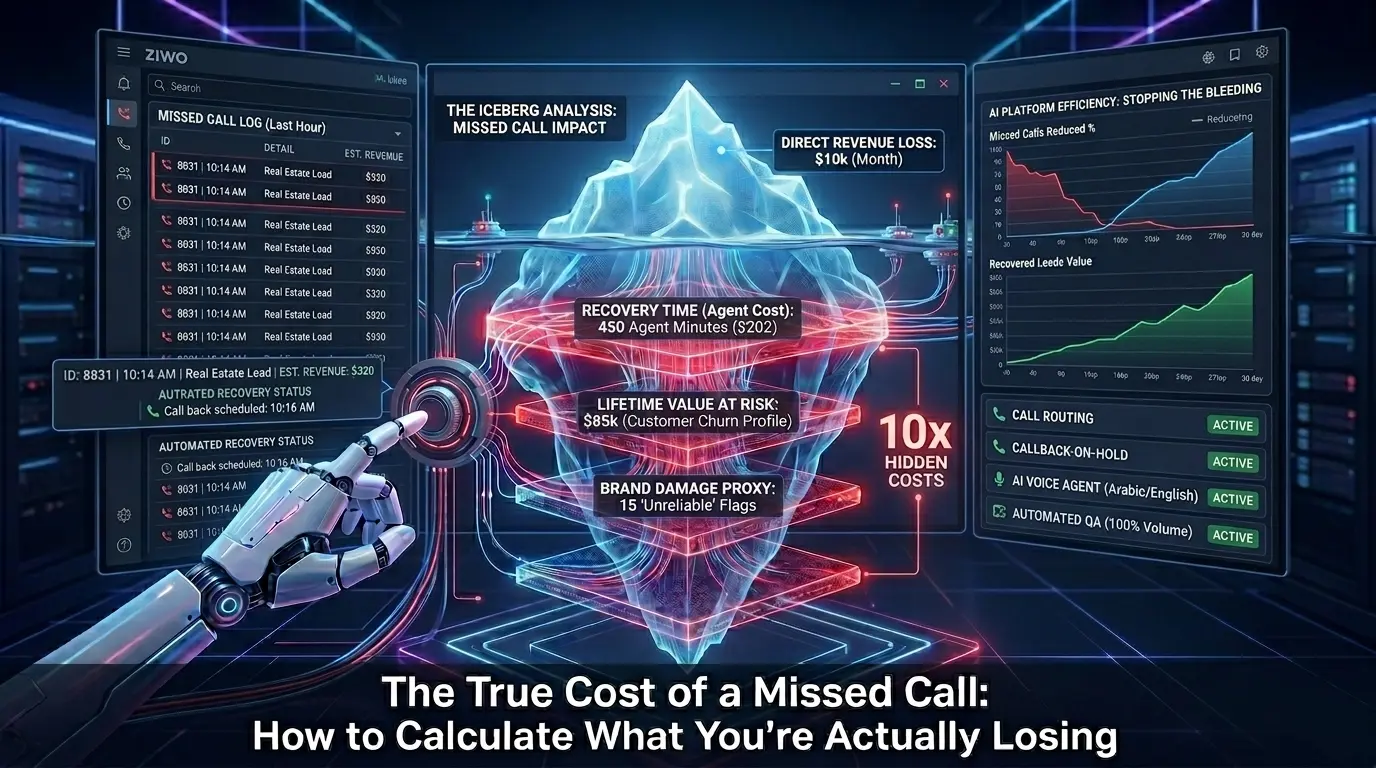
Most businesses underestimate missed calls by 10x
Ask any contact center manager how many calls they missed last month. You'll get a confident answer.
Now ask what those calls cost the business. You'll get a shrug.
That shrug is expensive.
A missed call is rarely just a missed call. It's a lost lead. A frustrated customer. A damaged reputation. And often, an agent's wasted time on the follow-up call that didn't need to happen.
Add those layers together, and the real cost is often 10 times what finance teams assume. Here's the math no one runs — plus a simple way to run it for your own business.
What a missed call actually costs
The full cost of a missed call has four layers. Ignore any of them, and you'll understate the problem.
1. Direct revenue loss.
If the call came from a sales lead, you lost the deal value multiplied by your conversion rate. For example, a real estate company taking inbound calls on a new development might convert 8% of leads at an average commission of $4,000. Every missed call is worth $320 in expected revenue — before anyone even picks up the phone.
2. Customer lifetime value at risk.
When an existing customer can't reach you, they don't just churn. They tell others. Harvard Business Review research has consistently shown that unhappy customers tell two to three times more people about a bad experience than happy customers tell about a good one. The math compounds fast.
3. Recovery cost.
Every missed call triggers a callback, a voicemail review, a CRM update, and sometimes an apology email. Industry benchmarks put this at 4 to 7 minutes of agent time per recovered call. And not every call gets recovered.
4. Brand cost.
This one is harder to quantify, but very real. A 2024 Forrester study found that 67% of customers who experienced a long hold time or unanswered call rated the brand as 'unreliable' — even after the issue was eventually resolved.
The simple formula you can run in 60 seconds
Here's a missed-call cost calculator you can copy into any spreadsheet:
Monthly missed call cost = (Missed calls × Average deal value × Conversion rate) + (Missed calls × Recovery time in minutes × Loaded agent cost per minute)
Let's run it for a mid-sized e-commerce support team:
- Missed calls per month: 600
- Average order value: $120
- Conversion rate on inbound calls: 18%
- Recovery time per call: 5 minutes
- Loaded agent cost: $0.45 per minute
Direct loss: 600 × $120 × 0.18 = $12,960 Recovery cost: 600 × 5 × $0.45 = $1,350 Total monthly cost: $14,310 — or roughly $171,000 a year.
And that's before factoring in brand damage and the lifetime value of customers who never come back.
The hidden cost of after-hours calls
After-hours and weekend calls are where the bleeding is usually worse. They're also the most invisible. Most managers only see daytime missed-call reports because that's when they're at the office.
Pull a 30-day report broken down by hour of day. In most contact center operations, 18 to 25% of inbound call volume arrives outside business hours. Almost none of it gets answered. And almost none of it gets followed up the next morning, because no one logged it.
Apply the formula above to your after-hours volume alone, and you'll typically double the cost you calculated.
The five industries where missed calls hurt most
Some industries lose far more per missed call than others. If you're in one of these, the calculator above probably understates your real loss.
Real estate. A single missed call during a project launch can cost a five- or six-figure commission. Speed-to-contact is the single biggest predictor of which broker closes the lead.
Finance and lending. Loan applications are time-sensitive. A missed call usually means the prospect submits an application with a competitor before you call back. In consumer lending, response times under two minutes correlate with conversion rates 4x higher than response within an hour.
Healthcare. Appointment bookings, prescription refills, and triage requests all flow through inbound calls. Missed calls translate directly into lost revenue and, sometimes, clinical risk.
Travel and hospitality. A missed booking call during a promotion window can lose an entire vacation package — typically the highest-value transaction a hospitality brand processes all year.
E-commerce. Pre-purchase questions are buyer signals. A missed call at the decision moment usually means the cart is abandoned for good. The customer often switches to a competitor for future purchases too.
Why missed calls happen
Missed calls are rarely a staffing problem. They're a coverage problem.
Volume spikes during launches. Working hours don't match customer time zones. Lunch breaks happen. And night shifts cost more than they return.
Throwing more agents at the problem rarely works. The smarter fix is contact center automation — using AI to absorb predictable, repetitive volume so your customer service teams can focus on conversations that actually need a human.
How AI is changing the math
The last three years have brought a major shift in how contact center operations handle inbound volume. An AI voice agent — sometimes called a virtual agent — can now answer calls in under a second, qualify leads, book appointments, and resolve common questions on its own.
This isn't a basic IVR with a friendlier voice. Modern AI voice agents use natural language processing (NLP) to understand what a caller actually wants. Then they take action against your CRM, calendar, or knowledge bases in real time.
Three capabilities are doing most of the work:
Conversational AI platforms. A conversational AI platform handles open-ended speech. Callers can describe their issue the way they would to a human, and the system understands. This is a fundamental upgrade from menu-based IVR, which forced customers to map their question onto someone else's menu structure.
Agentic AI. Newer AI voice agents go beyond conversation. They take action — booking the appointment, updating the CRM, sending the confirmation. This is what people mean when they talk about agentic AI: the system doesn't just talk, it does the work.
NLP customer service across channels. The same NLP engine that handles voice can power chat, WhatsApp, and email. That's the difference between a voice-only tool and a true omnichannel AI platform that follows the customer journey wherever it goes.
The four fixes that consistently work
Here are the four changes that move the needle most on missed calls:
Smart call routing. Make sure every call reaches the agent most likely to resolve it on the first try. ACD with skills-based routing reduces missed and abandoned calls by 20 to 30% in most deployments — the queue moves faster when fewer calls get transferred.
Callback-on-hold. Let callers hang up and keep their place in the queue. This single change cuts abandonment by up to half. Customers who would have given up after 90 seconds instead stay in your pipeline, and they enjoy noticeably reduced wait times the next time they call.
Overflow to an AI voice agent. During peak hours or after-hours, an AI voice agent can answer immediately, handle qualification, and escalate to a human only when needed. An AI voice agent handling 30% of overflow calls typically pays for itself within the first month.
Outbound auto-callback. When a call is missed, an automated callback within 60 seconds recovers a significant share of would-be lost leads. The customer hasn't moved on yet. Wait an hour, and they have.
These four automation workflows — alone or combined — turn the highest-leakage hour of the day into one of the highest-converting.
Your AI customer service buyer's guide: what to look for in a platform
Not every AI customer service platform delivers what it promises. If you're evaluating the best AI customer service software for your business, this short AI customer service buyer's guide covers the key features to compare.
Multilingual support. If you serve the Middle East, your platform needs more than English and basic Arabic. It needs to handle Khaleeji, Egyptian, and MSA dialects naturally. Most global tools fail this test.
True omnichannel coverage. Voice, WhatsApp, chat, and email should share the same customer journey, the same context, and the same AI engine. Anything less creates a fragmented experience.
Custom conversational flows. You should be able to build and edit your own conversation logic without writing code. Out-of-the-box flows are useful for a demo, but every business needs to automate routine processes its own way.
Automated quality assurance. Manual QA reviews 2 to 5% of calls. An automated quality assurance contact center tool reviews 100%. That's the only way to get actionable insights about what's actually happening across your full call volume.
Post-call analytics. Look for post-call analytics that surface real-time insights — sentiment, intent, resolution status, agent performance — automatically. Supervisors shouldn't be stuck listening to recordings to find coaching moments.
CRM and knowledge base integrations. Your AI contact center platform should plug into Salesforce, HubSpot, Zoho, and Microsoft Dynamics out of the box. It should also read from your existing knowledge bases, so customers get the same answers a human agent would give.
The best AI customer service software combines all of these into a single platform — not a stack of disconnected tools.
How automated QA and post-call analytics close the loop
Cutting missed calls isn't a one-time project. It's a service operation that needs continuous attention.
This is where automated quality assurance and post-call analytics come in. Modern AI customer service platforms analyze every conversation automatically. They flag the calls that went badly, the customers who sounded frustrated, and the topics that came up most often.
The result is a continuously improving feedback loop. Supervisors get actionable insights every morning instead of waiting for a monthly report. Coaching becomes targeted instead of generic. And over time, customers receive more customized experiences with shorter resolution times.
What about WhatsApp and other channels?
A common question: if a customer can reach you on WhatsApp, does a missed voice call still matter?
Yes — but less.
Multichannel deflection ('We're busy. Would you like us to message you on WhatsApp instead?') cuts the cost of a missed call significantly. The relationship isn't broken. The customer has simply moved to a channel where you can respond on your own time.
That's why most modern cloud contact centers — ZIWO included — bundle WhatsApp Business, voice, and an AI voice agent into a single omnichannel AI platform.
Frequently asked questions
What's a 'good' missed-call rate?
Under 5% is excellent. 5 to 10% is average. Anything above 10% suggests a systemic issue with staffing, routing, or coverage.
Should we count voicemail as a missed call?
Yes. A voicemail that doesn't get returned within 30 minutes converts at the same rate as a fully missed call.
Does an AI voice agent really sound human?
The newer generation does — especially when trained on your industry and language. For Arabic-speaking markets, dialect coverage matters more than overall voice quality.
How quickly can we deploy an AI voice agent?
With most modern AI contact center platforms, basic deployment takes one to two weeks. Custom conversational flows and CRM integration usually take another two to four.
Run your own number — then decide if it's worth fixing
If your monthly missed-call cost works out to more than the price of a modern AI customer service platform, the math has already made the decision for you.
ZIWO's cloud contact center automation includes smart ACD, callback-on-hold, WhatsApp deflection, automated quality assurance, post-call analytics, and an AI Voice Agent that handles overflow calls in Arabic, English, and French — turning your highest-leakage hour of the day into one of your highest-converting.
Book a demo and we'll run your missed-call cost calculator live, using your real numbers.


