

Every business that's considered automating its phone lines eventually hits the same worry: what if the AI sounds robotic, mishandles an upset customer, or worse, loses a lead because it didn't know what to do with the call? It's a fair concern. Most people have hung up on an automated system out of pure frustration at least once.
But that fear is usually based on an old idea of what an AI voice agent (sometimes called a virtual agent) does: play a menu, collect a few digits, and hope for the best. A modern AI contact center platform doesn't work that way anymore. The better ones, built on a true conversational AI platform rather than a scripted phone tree, operate on a simple principle: every call gets resolved, routed, or captured. Nothing gets dropped, nothing repeats itself for no reason, and nothing that should go to a human ever quietly disappears.
This is the logic worth understanding before you automate a single call, because it's also the difference between contact center automation that protects your customer journey and one that quietly damages it.
The Real Problem Isn't Automation. It's the Handoff.
Here's what the data actually shows: automation itself isn't the thing customers resent. Poor handoffs are. According to a PwC customer experience study, 73% of consumers say having to repeat information is one of the most frustrating parts of a support interaction, especially right after being transferred. That's not an AI problem specifically, it's a design problem that AI can make dramatically worse if it's not built to carry context forward.
Industry research backs this up starkly: only 15% of consumers report experiencing a truly seamless handoff from AI to a human agent. That gap is exactly where trust in automation breaks down. Someone spends two minutes explaining their issue to a bot, gets transferred, and then has to explain it all over again to a person who has no idea what was just said. It's exhausting, and it makes the AI feel like a wall instead of a tool.
The fix isn't to avoid AI. It's to make sure the AI never hands off blind. When context, transcripts, and intent move with the call instead of getting left behind, the handoff stops being the weak point.
Three Ways an AI Voice Agent Should Handle Every Call
A well-designed AI voice agent doesn't try to be everything. It's built to make one of three decisions on every single call:
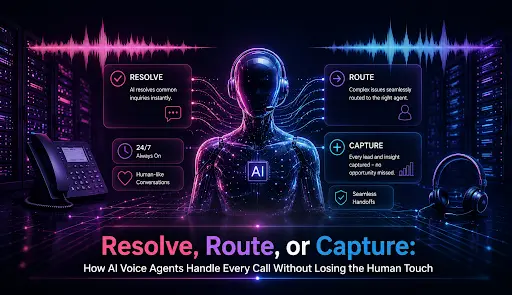
Resolve. For anything routine and well-defined, the agent handles it start to finish, no human needed. This is where an AI voice agent should automate routine work: payment confirmations, appointment scheduling, order status checks, or answering common questions pulled straight from your knowledge bases. Done well, it delivers customized experiences based on each caller's account history rather than a generic script, and it means reduced wait times across the board since no one is sitting in a queue for something a system can confirm instantly. This is where AI genuinely shines: fast, consistent, available at 2 a.m. as easily as 2 p.m. Recent benchmarking of production voice AI deployments shows well-configured systems achieving 85 to 90% customer satisfaction on calls that are fully resolved by the AI, with containment rates above 50%. That means more than half of all inbound calls never need to touch a human agent's queue at all, and the customers on those calls are, by and large, satisfied with the outcome.
Route. When a call needs a human, whether because it's complex, sensitive, or simply outside what the AI is authorized to handle, it gets transferred with full context: a summary, a transcript, and the reason for escalation, all attached. The human agent picks up already knowing what happened, so the customer doesn't have to start over. This is the step most AI systems get wrong, and it's the one that matters most. Research from Alibaba's customer service operations found that for technical escalations, handing off to a human with proper context preserves service quality even though the interaction takes longer. The problem shows up specifically when handoffs are clumsy or when emotional situations aren't recognized and routed quickly enough. In other words, routing done well protects the experience. Routing done poorly is where automation gets its bad reputation.
Capture. If the call comes in after hours, during a spike in volume, or simply at a moment when no one's available, the AI still doesn't let it go to voicemail. It captures the lead or the request, logs the details, and routes it to the right team for a fast follow-up. No missed opportunity, no dead end. This matters more than most businesses realize. A missed call after hours isn't just a missed call, it's a customer who may have already dialed a competitor by the time your team calls back the next morning.
That three-way logic is really the whole point. An AI voice agent isn't trying to replace judgment. It's applying a clear decision rule to every call, so nothing falls through the cracks, and everything that needs a human gets to one, fast and fully briefed.
Key Features of a Modern AI Contact Center Platform
Not every AI voice agent is built the same way, and the difference usually comes down to what's happening under the hood. Whether you call it an AI contact center platform, a conversational AI platform, or simply an AI customer service platform, a few key features separate the ones that hold up in production from the ones that only look good in a demo:
- Natural language processing (NLP) that understands intent, dialect, and code-switching, not just keyword matching. NLP customer service is what lets an AI voice agent tell the difference between "cancel my order" and "cancel my complaint," and respond accordingly instead of guessing.
- Live knowledge bases connected directly to the AI, so answers stay accurate as pricing, policies, or inventory change, instead of relying on a script that goes stale within a month.
- Post-call analytics and automated quality assurance that score every call automatically. This is what real automated quality assurance contact center tools should look like: full coverage instead of a supervisor sampling 2% of calls and calling it QA, with scoring that keeps continuously improving as it sees more conversations.
- Omnichannel AI platform reach, so the same conversational AI handles calls, chat, and messaging with one shared view of the customer journey instead of three disconnected systems.
- Agentic AI and automation workflows that trigger the next step in your CRM or helpdesk the moment a call ends, whether that's opening a ticket, updating a record, or alerting a support team.
- Real-time insights and actionable insights dashboards that show supervisors what's happening right now, not a report that lands the following week.
- Custom conversational flows built with no-code tools, so customer service teams can adjust what the AI says and does without waiting on a developer.
- Multilingual support, including regional dialects, for any service operation handling customers who don't all speak the same way.
Together, these are the features worth checking for in any ai customer service buyer's guide, since they're what turn contact center automation from a cost-cutting gimmick into something that actually improves contact center operations day to day.
Why "Losing the Human Touch" Is the Wrong Fear
Here's the part that tends to surprise people: customers don't actually object to AI handling their call. They object to AI handling their call badly, or to being stuck with no way out when they need a person.
Consumer sentiment data still shows a strong preference for human interaction when it matters. In Metrigy's 2025-26 Customer Experience Optimization study, 84.7% of participants said they'd prefer a human over an AI agent, and notably, 80.1% would still prefer a human even if assured their issue would be resolved either way. That's not a rejection of AI's competence. It's a preference for the option to reach a person, especially for anything that feels high-stakes or personal.
That's exactly why the resolve-route-capture model matters so much. It doesn't ask customers to choose AI or nothing. It keeps the human option open at every step, it just makes sure the AI is handling the parts that don't need a human in the first place, so your team's time goes toward the calls that actually benefit from a person.
The satisfaction numbers reflect this shift, too. Overall customer satisfaction with AI voice has climbed from 53% in 2022 to 72% today. Pure AI resolution now scores 4.1 out of 5 in customer satisfaction against 4.3 for human agents, a much narrower gap than most people assume. And when handoffs are done well, hybrid AI-human models are hitting 87% resolution rates with satisfaction scores of 8.7 out of 10. The technology has moved fast. The perception of it is still catching up.
What Good Resolve-Route-Capture Looks Like in Practice
Picture a call coming in at 9:47 p.m., well after your support team has gone home. A customer wants to confirm a delivery date and, partway through, mentions they also want to change their order. The AI voice agent answers immediately, in the language and dialect the customer is comfortable with, confirms the delivery detail on the spot (resolve), recognizes that changing an order needs a human's sign-off, and transfers the request to the morning shift with a full transcript and a one-line summary of what the customer needs (route). If no one were available at all, it would still log the request and flag it for immediate follow-up (capture).
Nothing about that interaction feels like the customer got shuffled into a dead end. It feels like the business was simply available, which is exactly the point.
Built for the Region: Why Language and Context Matter as Much as Logic
Resolve-route-capture logic only works if the AI can actually understand the customer in the first place. For businesses operating across the Middle East and North Africa, that means handling more than standard Arabic. Real calls involve dialect, and often a natural mix of Arabic and English within the same sentence, sometimes within the same breath. An AI voice agent trained only on formal Arabic or English will misfire constantly in these conditions, misrouting calls it should have resolved and mishandling context it should have captured cleanly.
This is also where integration matters as much as language. A resolve-route-capture model is only as good as the systems it's connected to. If the AI can't push a transcript into your CRM or helpdesk, or pull up account history before a call even connects, it can't actually carry context the way this model requires. That's the practical, unglamorous foundation underneath the whole idea: native integrations with the tools your support and sales teams already use, so a "route" isn't just a phone transfer, it's a fully briefed handoff inside the same system your customer service teams already live in. Modernizing contact center operations this way, with real multilingual support built in rather than bolted on, is what separates a genuinely useful AI contact center platform from one that only works in English demo calls.
How to Evaluate an AI Voice Agent: A Short AI Customer Service Buyer's Guide
If you're weighing whether to bring an AI voice agent into your call operations, the resolve-route-capture framework gives you a genuinely useful way to test any platform you're considering, and it doubles as a quick ai customer service buyer's guide for comparing vendors. Ask what percentage of calls it can resolve on its own, and for what call types specifically, not just as a marketing claim. Ask what a routed call actually looks like on the human agent's end: do they see a transcript and summary, or just an incoming ring with no context at all. Ask how post-call analytics and automated quality assurance are surfaced, whether the platform gives you real time insights or a lagging weekly report. And ask what happens to a call the AI can't fully handle and can't immediately route, because that's the scenario that determines whether you're protecting your pipeline or quietly leaking it.
The answers will tell you quickly whether a platform was built around this logic or bolted together around it, and whether it genuinely qualifies as the best ai customer service software for your call volume or just the best-marketed one. A voice agent that resolves what it can, routes what it can't with real context, and never lets a call disappear isn't trying to replace your team. It's making sure your customer service teams' time goes to the calls that actually need them, while every single caller, at any hour, gets an answer instead of a dead line.
That's the actual bar for an ai contact center platform now. Not whether it sounds human enough, but whether it makes every call count.
Frequently Asked Questions
Will an AI voice agent replace my support or sales team? No, and the data suggests customers don't want it to. Even in Metrigy's 2025-26 study, where satisfaction with AI has climbed sharply, the majority of consumers still want a human option available. The resolve-route-capture model is built around that reality: AI absorbs the repetitive, high-volume work so your team spends its time on the calls where a person genuinely adds value, not on payment reminders and appointment confirmations at midnight.
Does the AI sound robotic? The earliest generation of IVR systems did, which is where a lot of the skepticism comes from. Current voice AI, particularly systems trained on natural, dialect-specific speech rather than robotic text-to-speech, responds with the pacing and tone of an actual conversation. The tell isn't how the AI sounds on an easy call, it's how it behaves the moment a call gets complicated, which is exactly why the routing logic matters more than the voice quality alone.
Is this only useful for large enterprises? Not particularly. The economics tend to favor smaller and mid-sized teams just as much, since a single AI voice agent can absorb call volume that would otherwise require hiring additional staff for peak periods or after-hours coverage. The bigger question for any size of business isn't whether AI can technically handle the calls, it's whether the platform is built to route and capture correctly when it can't.
What's the difference between an AI voice agent and a broader conversational AI platform? An AI voice agent is one channel, phone calls, running on top of a conversational AI platform, which is the underlying engine handling natural language processing (NLP), intent recognition, and integrations. The best setups pair the two with an omnichannel ai platform layer, so a conversation that starts as a call and continues over chat doesn't lose context in between.
Curious what resolve-route-capture looks like for your own call volume? Book a demo to see ZIWO's AI Voice Agent handle a real call, in Arabic dialect, with full context passed to your team.


