

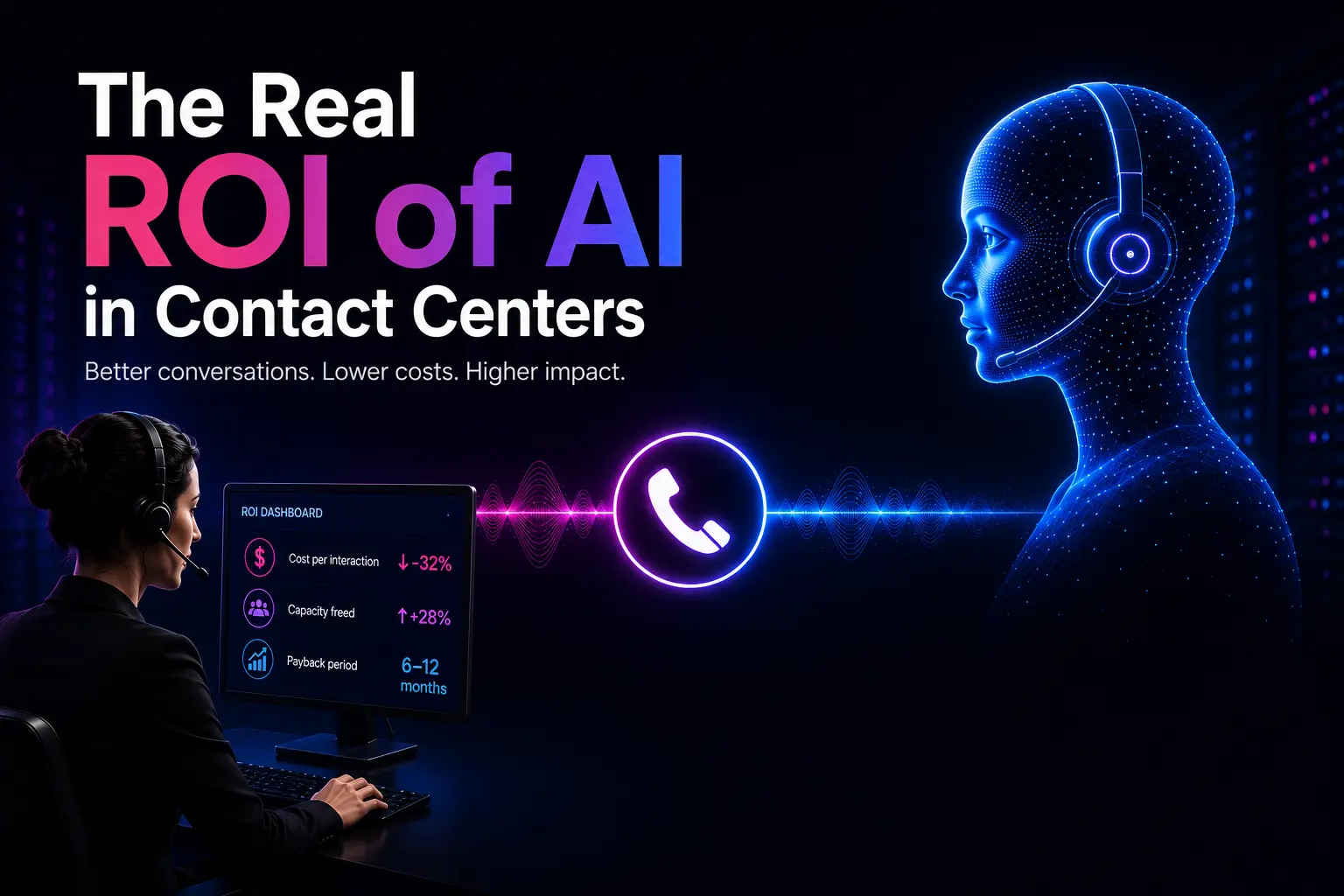
AI adoption in contact centers has moved past the pilot-project phase. Most operations leaders have seen the demos, read the vendor case studies, and heard the double-digit percentage gains. A harder question remains. What does AI ROI actually look like once the marketing language is stripped away?
This piece breaks down where AI in contact centers delivers real, measurable returns, where AI voice agent ROI tends to fall short of the pitch, and how to tell the difference before committing budget to an AI platform.
ROI starts with what AI is actually replacing
Labor costs tied to repetitive tasks drive the biggest share of contact center costs, more than any single piece of technology. Password resets, order status checks, and appointment scheduling are high-volume, low-complexity calls. These calls consume a large share of agent time relative to how much judgment they actually require.
This is where conversational AI delivers the clearest ROI. It doesn't replace complex customer interactions. It absorbs the volume that never needed a human agent in the first place. The real return comes from a straightforward shift: routine contact center operations move to AI, and human agents spend more time on calls that need their judgment.
Some AI ROI claims start to look inflated when a vendor implies AI will handle everything. Generative AI and agentic AI can extend into more complex tasks over time. They can draft responses, or even take action on a customer's behalf. But the first and most reliable wave of cost reductions comes from the high-volume, low-complexity calls, not the impressive edge cases shown in a demo.
The three numbers that show real AI ROI
Skip the vendor's aggregate efficiency percentage. It usually blends numbers in a way that makes the case look stronger than it is. Real ROI shows up in three specific places.
Cost per interaction
Calculate what a human-handled routine call costs today. Include agent time, average handle time (AHT), and overhead. Compare that figure against the cost of the same interaction resolved by an AI system. This comparison is the cleanest AI ROI signal available, because it's direct rather than a projected efficiency gain.
Capacity freed, not capacity cut
The strongest ROI stories aren't about smaller teams. They're about better-used ones. When AI absorbs high call volumes tied to repetitive tasks, agent capacity shifts toward complex resolution. This tends to improve first call resolution and customer sentiment on the interactions that still reach a human agent. A team handling fewer routine calls and more meaningful ones represents a real productivity gain, even when headcount stays flat.
Payback period
Take the implementation and subscription costs of the AI platform. Divide that figure by the monthly costs saved from deflected call volumes. This calculation identifies the month the investment breaks even. A 6 to 12 month payback is realistic for most contact centers that target high-volume, low-complexity call types first. If a vendor projects a faster payback, check the number against your own call volume data rather than an average pulled from their customer base.
Where AI ROI tends to underperform
Not every AI initiative produces the ROI promised at the sales stage, and it's worth being direct about why.
Wrong call types first. Teams sometimes deploy AI against complex, judgment-heavy conversations before proving the model on routine volume. This approach tends to produce poor resolution rates and frustrated customers. Weak early results erode the ROI case before it has a chance to build.
Weak knowledge base. An AI system is only as accurate as the knowledge base it pulls from. Gaps or outdated information show up quickly as wrong answers. Wrong answers create repeat calls, and repeat calls cancel out the cost savings the ROI case was built on.
No escalation clarity. When a call falls outside an AI system's scope, it needs to hand off to a human agent with full context. Clunky escalation makes customers repeat themselves. Satisfaction drops, and the "resolved" numbers used to calculate ROI stop reflecting the customer's actual experience.
Measuring resolution without measuring sentiment. A call can be technically resolved and still leave a customer frustrated. Tracking sentiment analysis alongside resolution rate catches this gap early, well before it shows up as churn or a lower CSAT score down the line.
What real AI ROI looks like in practice
A contact center that gets this right typically follows a clear pattern. Routine, high-volume calls, such as order status checks, appointment scheduling, and FAQ-style queries, shift to AI first. Cost per interaction on that volume drops meaningfully. This is often the clearest number in the entire case.
Human agents spend more time on complex resolution as a result. Average handle time on their remaining calls sometimes ticks up per call, but it produces better outcomes, since agents aren't rushing through routine work to get to it. Customers also tend to experience reduced waiting times on the calls AI handles directly, since routine questions get resolved on first contact rather than sitting in a queue.
The payback period lands within a reasonable window, usually inside a year for the initial use case. The numbers hold up under scrutiny for one key reason: they came from a real pilot, not a projection based on a vendor's benchmark.
How to verify AI ROI instead of assuming it
The fastest way to separate real ROI from an inflated pitch is to run a pilot before trusting any number a vendor provides. A 60 to 90 day test on one high-volume, low-complexity call type gives a contact center its own data. That data includes actual cost per interaction, actual capacity freed, actual customer sentiment, and an actual payback timeline.
Track a few supporting signals during the pilot as well. Watch how the AI affects conversion rates on any sales-adjacent interactions, and confirm the contact center operates smoothly during peak call volumes, not just average ones. These signals reveal whether the system holds up under real conditions, not just controlled ones.
Reporting these numbers honestly, including any areas where results fall short of projections, builds a stronger long-term case for AI adoption than an inflated first pitch that doesn't hold up once the system goes live. ROI that gets measured, rather than assumed, is the version that survives the next budget review.
AI Voice Agents built into the same platform agents already use carry escalations, call history, and CRM context automatically. This keeps the ROI story intact even as more call types move over to AI over the long term.


