

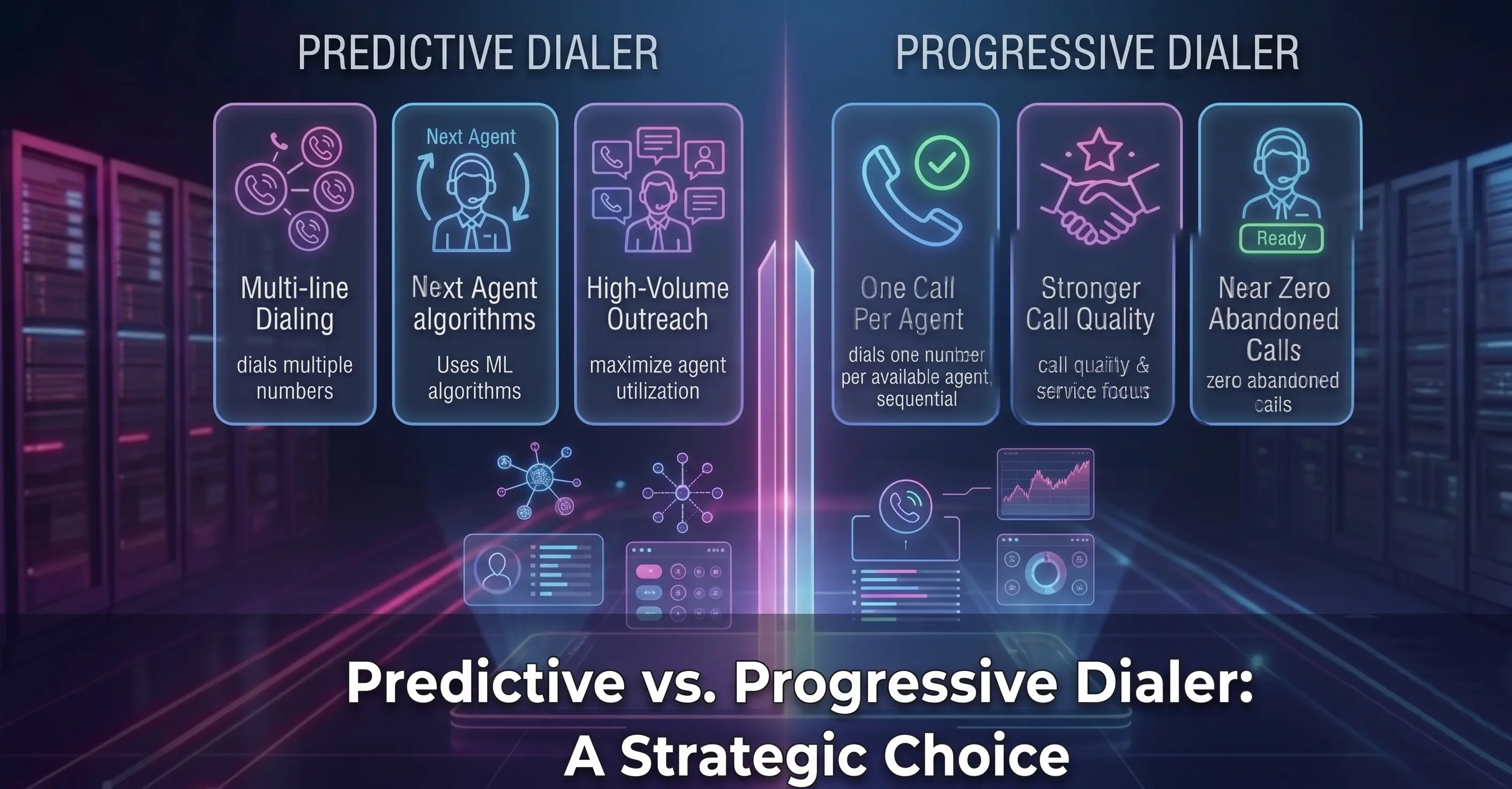
Many teams pick based on instinct — or based on what their last vendor recommended. The predictive dialer sounds faster. The progressive dialer sounds safer. Neither assumption is a reliable basis for a decision that directly affects call center agents, customer interactions, and campaign results.
Choosing the wrong dialer system costs real money in wasted agent time, abandoned calls, and damaged customer relationships. The right choice depends on what your outbound dialing strategy is actually trying to achieve.
This guide breaks down how each dialer works, where each one wins, and how to make the decision with confidence rather than assumption.
What Is a Predictive Dialer?
A predictive dialer is an outbound call center dialer that dials multiple numbers at the same time. It uses machine learning algorithms to forecast when call center agents will finish their current calls and become ready for the next one.
The dialer system does not wait for an agent to be free before placing calls. It draws on historical call data, average handle time, and live agent availability to calculate how many numbers to dial at any moment. The goal: ensure a live call is ready the instant an agent wraps up.
This approach maximizes agent utilization. Call center agents spend more time talking and less time idle. In demanding environments, a predictive dialer can raise agent talk time from roughly 40 minutes per hour to over 55 minutes per hour.
How predictive dialing works in practice
The dialer system tracks contact center activity in real time:
- Monitors how many call center agents are active and estimates when each will be free
- Reviews historical answer rates from the contact list to calculate the number of calls needed for each live connection
- Dials multiple numbers per available agent — a ratio of 2:1 to 4:1 based on campaign settings — to keep agents engaged without gaps
- Connects answered calls instantly to the next available agent via CRM integration
- Filters out voicemails and answering machines so call center agents handle only live customer interactions
The known trade-off: the dialer places calls before an agent is confirmed free. When that timing misfires, a customer picks up and finds no agent on the line. This is the abandoned call problem — and it is the key compliance and call quality challenge of predictive dialing.
'A predictive dialer keeps every call center agent in conversation, every minute of the shift. When volume is the goal, no other dialer system comes close.'
When predictive dialers make sense
- Large outbound teams with 15 or more call center agents running at the same time
- High-volume outbound sales campaigns where speed matters more than call depth — payment reminders, lead generation, outbound surveys
- Campaigns with large contact lists and variable answer rates
- Operations with solid compliance systems in place to monitor the abandonment rate
What Is a Progressive Dialer?
A progressive dialer takes the opposite approach to outbound dialing. The dialer system places one call at a time, and only dials when an agent is confirmed available.
As soon as an agent finishes a call, the system selects the next contact from the list and dials. The agent connects before the customer picks up — which means every answered call has a live agent ready. Abandoned calls drop to near zero.
Progressive dialers are slower by design. They trade raw call volume for call quality — and in the right context, that trade delivers stronger results.
How progressive dialing works in practice
- The dialer system tracks agent availability in real time
- As soon as an agent completes a call and becomes free, the next number dials automatically
- CRM integration surfaces customer data and contact history on the agent's screen before the call connects
- Calls that reach voicemail are skipped automatically — no agent time wasted
- Call center agents are live and ready when a customer picks up — every time
The customer experience is noticeably better. Calls feel deliberate rather than robotic. Call center agents benefit too: a steady pace gives them time to review customer data between calls and deliver more personal outreach.
'Progressive dialing wins on call quality, not volume. In retention, renewals, and B2B sales, that is the metric that drives revenue.'
When progressive dialers make sense
- Smaller teams of 5 to 15 call center agents where volume is a lower priority
- Campaigns focused on existing customers — renewals, retention, and post-sale follow-ups
- B2B outreach where each customer interaction is a relationship touchpoint
- Industries with strict compliance standards — healthcare, financial services, insurance
- Campaigns where a poor customer interaction would cause lasting brand damage
Predictive vs. Progressive Dialer: Side-by-Side Comparison
The table below covers the key features that matter most when choosing an outbound call center dialer:
| Feature | Predictive Dialer | Progressive Dialer |
| Dialing logic | Dials multiple numbers at once using ML algorithms | One call per available agent, sequential |
| Primary goal | Maximum call volume & agent utilization | Call quality & customer service |
| Abandoned calls | Higher risk — call center agents may not be ready in time | Near zero — agents confirmed ready before each dial |
| Best team size | 15+ call center agents | 5–15 call center agents |
| Best for | Debt collection, mass lead generation, outbound surveys | Renewals, B2B sales, retention, compliance-heavy sectors |
| CRM integration | Full — auto-pulls contact list and logs each call | Full — displays customer data before the call connects |
| Call recording | Included — full campaign call quality tracking | Included — supports coaching and compliance review |
| Compliance risk | Higher — requires active abandonment rate monitoring | Lower — one-to-one model meets most regulatory standards |
| Agent experience | High number of calls, less prep time per interaction | Steady pace, more context before each customer interaction |
| Setup complexity | Higher — algorithm tuning needed | Lower — simpler to deploy and manage |
The Real Decision: Volume vs. Value
Most comparison guides treat predictive dialer vs progressive dialer as a technical question. The decision is strategic, not technical.
The right question to ask: what does success look like for this specific campaign, and what does a failed call actually cost?
Choose a predictive dialer when the cost of a missed connection is low
In high-volume outbound campaigns — lead generation, payment reminders, survey collection — no single abandoned call carries much weight. Total contact rate across the full list is what matters. A predictive dialer is purpose-built for this environment.
When call center agents handle 80 to 150 calls per shift and the goal is outreach at scale, predictive dialing delivers stronger results than any other dialer system.
Choose a progressive dialer when the cost of a poor call is high
In retention, renewal, or B2B outreach campaigns, call quality defines outcomes. A poor customer interaction — dead air, no context, an agent caught off guard — can close a door that takes months to reopen.
Progressive dialing removes that risk. Every call is deliberate. Every call center agent is prepared. The investment in call quality pays back in customer lifetime value, not raw call count.
Compliance: A Factor Most Teams Underweight
Predictive dialers need active monitoring to stay within abandonment rate limits set by regulators across the MENA region and globally. In the US, for example, the TCPA sets a 3% maximum abandoned call rate. Similar rules apply in most markets ZIWO customers operate in.
Progressive dialers follow a one-to-one dialing model by design. Each call has a confirmed agent. The abandonment rate risk does not exist in the same way. For contact centers in heavily regulated industries, this difference can determine which dialer system is viable at all.
How ZIWO Approaches Outbound Dialing
ZIWO's view: the dialer is a means, not an end. The customer interaction is the point.
ZIWO's Predictive Dialer gives contact center managers the tools to scale outbound dialing without losing visibility into what happens on each call. The algorithm adjusts the dialing pace in real time — drawing on live agent availability and campaign data, not fixed ratios configured at setup.
Supervisors monitor all outbound activity as it happens. Every campaign generates actionable data: connection rates, talk time, abandonment rate, call recording access, and agent performance by contact list segment.
When a campaign calls for a progressive approach — relationship-driven outreach, high-value accounts, or compliance-sensitive sectors — ZIWO supports that within the same contact center solution, on the same platform.
'The best dialer system matches the campaign goal. ZIWO gives contact center teams both options — and the data to choose correctly.'
The Bottom Line
Predictive and progressive dialers solve different problems. Contact centers that match the right dialer to each campaign type consistently outperform those that rely on a single default approach.
When speed and volume drive the campaign, and compliance systems are in place, a predictive dialer raises outbound performance.
When call quality and customer relationship depth drive the campaign, a progressive dialer protects what matters most.
Most growing contact centers will reach a point where both dialer systems have a role — and the judgment to know when to use which becomes a real competitive advantage.
Frequently Asked Questions
What is the main difference between a predictive dialer and a progressive dialer?
A predictive dialer dials multiple numbers at once and uses algorithms to match answered calls to available call center agents, maximizing the number of calls per hour. A progressive dialer places one call per available agent, ensuring every customer interaction has an agent ready. Predictive dialing focuses on volume; progressive dialing focuses on call quality and customer service.
Which dialer system works better for small contact center teams?
Progressive dialers suit smaller teams of 5 to 15 call center agents. Predictive dialers rely on having enough agents active at once to manage dialing ratios effectively. With fewer agents, predictive dialing produces more abandoned calls and less consistent performance across the contact list.
Do predictive dialers comply with regulations?
Yes, with active monitoring. Regulatory frameworks in the MENA region and globally set limits on the abandonment rate for outbound dialing campaigns. ZIWO's Predictive Dialer includes built-in compliance tools to help contact center teams stay within required thresholds and avoid penalties.
Can a contact center use both a predictive and a progressive dialer?
Many contact centers run both. High-volume outbound sales campaigns benefit from predictive dialing, while retention and renewal campaigns with existing customers are better served by a progressive approach. ZIWO's contact center solution supports both dialer types within a single platform.
What is the difference between a predictive dialer and a power dialer?
A power dialer places one call per agent and moves to the next number automatically when a call ends. It does not manually dial, but it also does not check whether the agent is ready before placing the next call. A predictive dialer dials multiple numbers per agent at the same time and uses real-time data to adjust the pace. A power dialer sits between progressive and predictive in terms of speed and control — useful for smaller teams that want to eliminate manual dialing without the full complexity of a predictive system.
What is CRM integration in outbound dialing?
CRM integration connects the dialer system directly to the contact list and customer records stored in a CRM platform. When a call connects, the customer's history, past interactions, and key data appear on the call center agent's screen automatically. This supports better customer service, reduces the time agents spend searching for context, and improves call recording accuracy for compliance and coaching purposes.
Want to see ZIWO's Predictive Dialer in action? Book a demo and explore how intelligent outbound dialing can raise performance across your contact center.


